
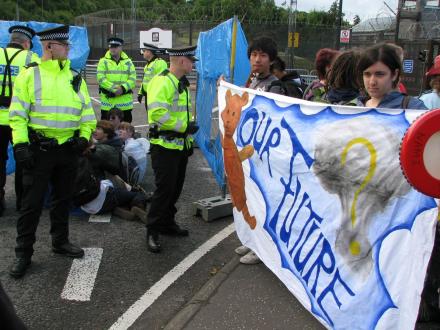
 Faslane, 28th July 2007 — eight young people from Wales, Germany and Belgium have been arrested this morning, blockading the gate at Faslane Nuclear Base in a protest against the renewal of the British Trident Nuclear weapons system. The blockade came amongst lively and colourful actions carried out by young people from many countries, from Wales and Germany to Japan and the US. The action takes the number of arrests during the “Faslane 365” year long blockade of Faslane naval base to over 900.
The group decided to take action after having met at an ‘academy’ in Glasgow where they discussed the issue of Trident nuclear weapons in the context of Europe and the rest of the world. They decided that Trident Replacement, which the British Parliament voted for this spring, is not only a current British issue but will also affect and endanger the next generation across the world.
They made a human knot in the road at the North Gate entrance to the base and stuck their hands together with super glue to make it as difficult as possible for the police to remove them. They were supported by action from an international clown army, a simultaneous teddy blockade, dancing and music from Japanese students and the poignant speech of a Hibakusha (Hiroshima survivor).
The blockaders included five people from Wales (Pembrokeshire), Hannah Chester (15), Naomi Proszynska (15), Georgia Coles-Riley (16) Alexander Ferraro (19) and Craig Wilkinson (18). For some this is their second arrest as they have already been active in the Faslane365 campaign which has been running since October 2006. There were also two blockaders from Germany, Stefan Hittmeyer (21) and Tobias Bollinger (22) and one from Belgium, Andy Vermaut (30).
Naomi Proszynska from Wales said:
“Blockading at Faslane changed the way I look at things. The reason why young people are not active on these issues is not because they don’t care about them, it’s because they don’t know about them.”
The young people decided to take action to raise awareness among all young people that any nuclear weapons are a danger to everyone. They also planned an awareness-raising media campaign, a European Postcard competition on nuclear weapons and have been keeping a blog at www.bang-europe.org. This will be continued by five girls who will travel with Japanese Peace Boat to New York.
It is almost impossible for the youth of today to imagine a world without nuclear weapons, let alone a future.
ENDS
Interviews are available in English, Welsh and German. Please contact Emily Freeman in the first instance (+44) 01436850047 or emfreeman@hotmail.co.uk
[Alternatively (+44) 07828 658 628]
Photographs available, free from copyright:
http://www.faslane365.org/photos
More information:
BANg : www.bang-europe.org
Faslane 365: www.faslane365.org
Peace Boat: www.peaceboat.org
The “action academy” being held between 26th – 30th July was attended by young people, from Germany, Wales, Belgium, Austria, France, the US, Japan and many other European countries. They have been joined by students from the Japanese Global University who arrived on the Peace Boat as it travels between Japan and New York.
An international postcard design competition is being held to raise awareness of nuclear issues among young people. There will be an award ceremony at the event and the winning designs will be distributed as postcards on Nagasaki day (9th August).
The protest aims point out to the British Government, and other governments across Europe and the world, that nuclear weapons and, specifically, Trident replacement, are an international issue, and already affects people across the world. The consequences of nuclear weapons know no boundaries and pollute and destroy huge areas of the planet for ever.
Peace Boat:
Following the actions, five of the participants, two from Wales, two from Austria and one from Germany, will be joining the Global university onboard Peace Boat to take part in their summer programme on Peace and Nuclear Weapons as they voyage from Dublin to New York (31st July – 9th August). The participants will be sharing information and learning about US, French and British nuclear weapons in Europe and examining cultural and personal issues around the nuclear threat, with students of the Global University. Hiroshima Day will be commemorated on board Peace Boat on 6th August and Nagasaki Day on arrival in New York on 9th August.
Since the 1950s studies have shown that the threat of nuclear war has damaged the psychological health of young people and society in general. Over 6o years later, since the first use of nuclear by the US in 1945, that damage continues. The awareness of the possibility of nuclear war awareness has a negative impact on the feelings, emotions, perception of life, and plans for the future of young people. The younger generation constantly lives with consciousness of the tremendous danger of nuclear war and perceives it more acutely than adults. Fear, anxiety, helplessness, and lack of confidence in the future leave an ominous imprint on the personality of the youth worldwide. Many are already victims of a war which has not yet started.