
Misdirection & Target Selection, Part 2

Part 1 pre­sent­ed an overview of the need for strate­gic tar­get selec­tion. With the indus­tri­al econ­o­my bar­rel­ing ever onwards, drag­ging the world towards biot­ic col­lapse, the impor­tance of tar­get­ing our efforts can­not be over­stat­ed. Iden­ti­fy­ing and strik­ing at key tar­gets is nec­es­sary for any social change move­ment to be suc­cess­ful, and this is all the more true for rad­i­cal move­ments that seek to fun­da­men­tal­ly change sys­tems of oppres­sive pow­er.

Yet for all our earnest­ness and urgency, our move­ments have (for the most part) failed to tar­get the key nodes of cap­i­tal­ist and indus­tri­al sys­tems.
With so many ter­ri­ble things hap­pen­ing, we slide into a mode of reflex­ive defen­sive­ness, shift­ing hap­haz­ard­ly from one man­i­fes­ta­tion of civilization’s destruc­tive­ness to anoth­er, with­out any coher­ent plan to stop the machine respon­si­ble for all the car­nage.
Devoid of a way to make tan­gi­ble progress towards that goal, we are doomed to inef­fec­tive­ness: we become fix­at­ed by sym­bol­ism and direct our efforts towards sym­bols of that which we oppose, rather than mate­r­i­al struc­tures of pow­er.

Take for instance, this com­mu­nique from Indone­sia, pub­lished at 325.nostate.net:

Cov­ered by the night, we burned a pri­vate car in Tomo­hon (small city in North Sulawe­si), owned by an unknown per­son. It was a car locat­ed near the local TV sta­tion in that town. A car as a sym­bol of slav­ery, eco-dis­as­ter and the mean­ing­less­ness of life.

Yes, cars are ter­ri­ble. Count­less peo­ple and ani­mals are killed every day by vehi­cles. And car cul­ture has become emblem­at­ic of indus­tri­al soci­ety and the lack of mean­ing and con­nec­tion avail­able in mod­ern cap­i­tal­ist soci­ety.

But how does this advance the cause of rev­o­lu­tion? How does this change the struc­tures (indus­tri­al soci­ety and cap­i­tal­ism) that are to blame for “slav­ery, eco-dis­as­ter and the mean­ing­less­ness of life”?

Or this com­mu­nique from Greece, pub­lished on the same site:

We claim the respon­si­bil­i­ty for the incen­di­ary attack at the house of ex-min­is­ter of Econ­o­my and Nation­al Defence, Gian­nos Papan­do­niou. We arrived out­side the door of his man­sion on Olympias street in Kifis­sia and torched the two cars used by him and his “wife” Roula Kourak­ou for their mean­ing­less movements….Far from a pop­ulist rhetoric we iden­ti­fy in the face of Gian­nos Papan­do­niou an offi­cer of author­i­ty. We are not inter­est­ed in list­ing the dodgy things he has done, although he sure­ly has done many. Either way, cor­rupt­ed or not cor­rupt­ed, state offi­cers, irrel­e­vant­ly if they hold their posi­tions in the state mech­a­nism, are a per­ma­nent tar­get for the insur­rec­tion­ist dig­ni­ties.

None of us like politi­cians, nor the rich­es and rewards they receive for pre­sid­ing over oppres­sive and destruc­tive sys­tems of pow­er. In exchange for their proac­tive alle­giance to and pro­lif­er­a­tion of the sta­tus quo, they’re afford­ed pow­er and priv­i­lege, which lasts long after their terms in office end.

But again, how does burn­ing the car of an ex-politi­cian move us tan­gi­bly clos­er to achiev­ing our goals, towards dis­man­tling the sys­tem of which politi­cians are a sin­gle com­po­nent? How does such an attack effect change on the sys­tems which pre­serve and enable injus­tice and oppres­sion?
This isn’t meant to be a hos­tile attack on the courage or con­vic­tion of those who take action like this; nei­ther their com­mit­ment nor their readi­ness to take action is at ques­tion. This is sim­ply to pose the ques­tion “is this real­ly the most effec­tive way to accom­plish our goals?”

And need­less to say, this cuts both ways. Most of the more main­stream groups and ini­tia­tives fall just as flat. Cur­rent­ly, one of the most promi­nent pro­gres­sive cam­paigns is 350.org’s ‘Fos­sil Free’ cam­paign, which seeks to tar­get uni­ver­si­ties and reli­gious insti­tu­tions to divest their endow­ments from fos­sil fuel com­pa­nies. This strat­e­gy is def­i­nite­ly an improve­ment on past efforts, which con­sist­ed of plead­ing to politi­cians; this new ini­tia­tive iden­ti­fies a struc­tur­al prob­lem and aims to address it. Yet there are some obvi­ous and imme­di­ate prob­lems with the strate­gic via­bil­i­ty of this plan, and whether uni­ver­si­ty invest­ments in fos­sil fuels present a worth­while tar­get.

The fore­most issue is that indus­tri­al soci­ety is entire­ly depen­dent upon fos­sil fuels in order to func­tion and with­out an abun­dant & avail­able sup­ply would quick­ly col­lapse (which would be a very good thing!). Fos­sil fuel com­pa­nies already receive tens of bil­lions of dol­lars in fed­er­al sub­si­dies; if their via­bil­i­ty was in seri­ous jeop­ardy, we can safe­ly assume that gov­ern­ments the world over would rush to their aid. Indeed it would be dan­ger­ous to assume oth­er­wise. The extrac­tion and use of fos­sil fuels can’t be effec­tive­ly chal­lenged or stopped work­ing through the indus­tri­al cap­i­tal­ist sys­tem, because fos­sil fuels are an inte­gral struc­tur­al sup­port of indus­tri­al cap­i­tal­ism and it could not exist with­out them.
And beyond this, it’s entire­ly un-estab­lished whether divest­ments by uni­ver­si­ties would even have a mean­ing­ful impact of the eco­nom­ic via­bil­i­ty of fos­sil fuel com­pa­nies. How much such invest­ments con­sti­tute is unknown.

This isn’t to say that such a cam­paign is a waste of efforts or that it’s a bad thing. Any­thing that brings peo­ple togeth­er around struc­tur­al prob­lems inher­ent to this way of life is a good thing. And eco­nom­ic pres­sure, as we saw in South Africa, can con­tribute to a larg­er cam­paign that includes oth­er tac­tics, such as force­ful non­vi­o­lence, inter­na­tion­al polit­i­cal pres­sure, and strate­gic sab­o­tage. This is just to say that if the goal is to shut down fos­sil fuel pro­duc­tion or cor­po­ra­tions, uni­ver­si­ties invest­ments in the indus­try don’t present a very impor­tant tar­get.

A quick eval­u­a­tion of these actions through the lens­es of the CARVER Matrix gives us a more crit­i­cal analy­sis of the val­ue of these tar­gets.
In the last bul­letin on tar­get selec­tion, we pre­sent­ed an overview of the CARVER Matrix, a tool used ass­es the strate­gic val­ue of attack­ing a tar­get. Obvi­ous­ly, this is not an end-all-be-all; how a tar­get appears through CARVER is not the final and absolute deter­mi­na­tion as to whether it presents a worth­while tar­get. But it is unde­ni­ably a strong ana­lyt­i­cal tool from whose use we can ben­e­fit and learn much.

Crit­i­cal­i­ty: will the destruc­tion, dam­age or dis­rup­tion of the tar­get have sig­nif­i­cant impact on the oper­a­tion of an enti­ty?

The per­son­al cars of one or two indi­vid­u­als are irrel­e­vant to the func­tion­ing of indus­tri­al­ism or capitalism—consider all the thou­sands of cars wrecked every year in col­li­sions. This goes for the cars of polit­i­cal fig­ures, such as Gian­nos Papan­do­niou, as well.

As for uni­ver­si­ty invest­ment port­fo­lios, they aren’t crit­i­cal to the func­tion of indus­tri­al­ism or the fos­sil fuel indus­try either. Such cor­po­ra­tions don’t have much trou­ble find­ing cap­i­tal (as the vital­i­ty of the entire econ­o­my rests upon an avail­able sup­ply of fos­sil fuels), and they already receive mas­sive sub­si­dies from gov­ern­ments.

Acces­si­bil­i­ty: how fea­si­ble it is to reach the tar­get with suf­fi­cient peo­ple and resources to accom­plish the goal?

Cars are very acces­si­ble; peo­ple park them all over the place and they are almost nev­er guard­ed or pro­tect­ed, as was the case in both of the actions men­tioned above.

Invest­ments are not very acces­si­ble at all as tar­gets, with deci­sion mak­ing pow­er rest­ing with­in the com­plex struc­tures of uni­ver­si­ty admin­is­tra­tions. Addi­tion­al­ly, peo­ple with access to these sys­tems (e.g. stu­dents or fac­ul­ty) are nec­es­sary for each dis­tinct uni­ver­si­ty, requir­ing engage­ment on a mas­sive scale. Fur­ther­more, it is entire­ly unknown how much such invest­ments even amount to.

Recu­per­abil­i­ty: how quick­ly will the dam­age done to a tar­get be repaired, replaced or bypassed?

Per­son­al cars are wide­ly avail­able and can eas­i­ly be replaced, pro­vid­ed one can afford them. For pow­er­ful insti­tu­tions and indi­vid­u­als, vehi­cles are eas­i­ly replaced, but for the aver­age per­son ran­dom­ly tar­get­ed by insur­rec­tionary arson, not so much. And a polit­i­cal fig­ure who can afford two lux­u­ry cars and body­guards is unlike­ly to declare bank­rupt­cy for the loss of one (or two, or a dozen) of their per­son­al cars.

Again, fos­sil fuel cor­po­ra­tions are not starved for funds, and con­tin­ue to post record prof­its. And being that the ‘goods’ they pro­duce are fun­da­men­tal to indus­tri­al soci­ety, they can pass on any loss­es they sus­tain to con­sumers at the pump, who have lit­tle choice but to pay the price. Fos­sil fuel com­pa­nies are incred­i­bly prof­itable (because our way of life is depen­dent upon the prod­ucts they sup­ply), and that makes them desir­able investments—that will con­tin­ue to be true whether or not uni­ver­si­ties and church­es hold stock in them. Thus these invest­ments can be con­sid­ered very recu­per­a­ble.

Vul­ner­a­bil­i­ty: Are there suf­fi­cient means to suc­cess­ful­ly dam­age, dis­able, or destroy the tar­get?

Destroy­ing a car doesn’t require many peo­ple, many resources, or hard­ly any tech­ni­cal knowl­edge, so they are def­i­nite­ly vul­ner­a­ble tar­gets.

To change the invest­ment behav­iors of edu­ca­tion­al insti­tu­tions requires a mas­sive num­ber of peo­ple work­ing from with­in their uni­ver­si­ties to lob­by their admin­is­tra­tions to change. Because many uni­ver­si­ties are pri­vate insti­tu­tions, there are few ways to agi­tate and force change (pri­vate insti­tu­tions can kick out stu­dents and aren’t oblig­at­ed to lis­ten to them), and the only option left is to lob­by the admin­is­tra­tion to enact pol­i­cy change. Due to these fac­tors, it’s doubt­ful whether such uni­ver­si­ty invest­ments can be con­sid­ered vul­ner­a­ble.

Effect: What are the sec­ondary and ter­tiary impacts of suc­cess­ful­ly attack­ing the tar­get?

The destruc­tion of a sin­gle ran­dom car (or even the car of a for­mer gov­ern­ment offi­cial) is unlike­ly to have sig­nif­i­cant polit­i­cal or social effects—except for the per­son the car belonged to. If cars were repeat­ed­ly attacked, it’s pos­si­ble there would be a response by local police. But it won’t have much of any impact on any major effects oth­er than cre­at­ing one more pedes­tri­an.

Sim­i­lar­ly, there are unlike­ly to be any seri­ous sec­ond-hand ram­i­fi­ca­tions of uni­ver­si­ty divest­ment cam­paigns, sim­ply because it is a rel­a­tive­ly minor facet of the fos­sil fuel indus­try. How­ev­er, the suc­cess of this cam­paign would cer­tain­ly be a way to broad­en the con­ver­sa­tion about cli­mate change and fos­sil fuels, as well as broach­ing on a con­ver­sa­tion about the struc­tur­al deter­mi­nants of cap­i­tal­ism itself.

Rec­og­niz­abil­i­ty: will the attack be rec­og­nized as such, or might it be attrib­uted to oth­er fac­tors?

I can’t imag­ine any­one attribut­ing the burn­ing of a ran­dom car to rev­o­lu­tion­ary groups, and if so, I doubt they would do so in a pos­i­tive light. The attack of a spe­cif­ic polit­i­cal figure’s car may be dif­fer­ent, but again, it’s unclear with­out fur­ther expla­na­tion that such an attack was car­ried out with rev­o­lu­tion­ary intent, as opposed to pyrotech­nic hedo­nism.

In regards to 350.org’s cam­paign, if activists were to suc­cess­ful­ly move scholas­tic endow­ment funds out of fos­sil fuel stocks and invest­ments, they would undoubt­ed­ly be rec­og­nized for doing so, pri­mar­i­ly because there’s sim­ply no way it would hap­pen oth­er­wise.

Clear­ly, none of these present espe­cial­ly desir­able targets—neither indi­vid­ual cars nor uni­ver­si­ty endow­ment invest­ments in fos­sil fuels are par­tic­u­lar­ly crit­i­cal to the func­tion of the sys­tems of pow­er we seek to dis­man­tle, and that must be our fore­most cri­te­ria.

One could argue that these tar­gets are pri­mar­i­ly sym­bol­ic, that they were cho­sen in hopes of rais­ing aware­ness about the prob­lems of cap­i­tal­ism and indus­tri­al soci­ety. This how­ev­er, is pre­cise­ly the prob­lem. For decades we’ve been cru­sad­ing against sym­bol­ic tar­gets, attack­ing micro­cosm-man­i­fes­ta­tions of the larg­er struc­tures which are actu­al­ly dis­mem­ber­ing the plan­et, instead of focus­ing our efforts on those struc­tures them­selves. Earth is not being strip-mined, clear-cut and plowed to death by sym­bols or metaphors; phys­i­cal infra­struc­ture is required to do that. Our work needs to reflect that mate­ri­al­ism; like the machines doing the dam­age to the bios­phere, our tar­gets need to be mate­r­i­al, crit­i­cal com­po­nents of indus­tri­al infra­struc­ture.

This is a strate­gic rut of dis­as­trous pro­por­tions into which we’ve col­lec­tive­ly got­ten our­selves stuck, and we’re in des­per­ate need of a strong push if we’re to get out of it, and move onto suc­cess­ful­ly dis­man­tling the destruc­tion per­pe­trat­ed by indus­tri­al soci­ety.

As so many have so right­ly said, polit­i­cal change requires the appli­ca­tion of force. But that force needs to be pre­cise, aimed at the cor­rect targets—vital nodes with­in the dom­i­nant struc­tures of pow­er. Unless we select and strike at the right targets—the ones that are crit­i­cal to sys­tem func­tion, acces­si­ble, min­i­mal­ly recu­per­a­ble, and are vul­ner­a­ble giv­en our resources—we’ll be inef­fec­tu­al­ly burn­ing ran­dom objects and plead­ing hope­less­ly with the pow­er­ful until the cows come home, or until they too pass from Earth.
Indigenous resistance forces Malaysia to scale back twelve dam megaproject

A Malaysian state min­is­ter Fri­day said the gov­ern­ment would not push ahead with build­ing a dozen new dams on Bor­neo island, acknowl­edg­ing they have caused out­rage from local tribes and envi­ron­men­tal­ists.

A Malaysian state min­is­ter Fri­day said the gov­ern­ment would not push ahead with build­ing a dozen new dams on Bor­neo island, acknowl­edg­ing they have caused out­rage from local tribes and envi­ron­men­tal­ists.

The pro­pos­als sparked fears that the dams would destroy pris­tine rain­forests, endan­ger wildlife, and dis­place natives in Sarawak, a Malaysian state crossed by pow­er­ful rivers with rich jun­gle habi­tats.

“It is not a firm plan to build 12 dams. I don’t think we will need that. We will only need four,” James Mas­ing, Sarawak’s state min­is­ter of land devel­op­ment, told AFP in an inter­view.

Mas­ing said the gov­ern­ment was back­ing off in response to wide­spread crit­i­cism. Protests over the years have seen activists and locals stag­ing block­ades of roads into dam areas.

“I’m pleased that this type of thing (protests) takes place. Not all that we do is cor­rect, and this shows we need to refine our plans and think again,” he said.

The now-com­plete Bakun mega-dam, which is not part of the new dam pro­pos­al, has already been dogged for years by claims of cor­rup­tion in con­struc­tion con­tracts, the flood­ing of a huge swathe of rain­for­est and the dis­place­ment of thou­sands of tribes­peo­ple.

Despite that, the gov­ern­ment moot­ed con­struct­ing more dams as part of an indus­tri­al devel­op­ment dri­ve to boost the resource-rich state’s back­ward econ­o­my.

Anoth­er dam at Murum, also deep in the inte­ri­or, is near­ing com­ple­tion and two oth­ers are in the plan­ning stages as part of the new pro­pos­al.

Togeth­er the four dams — at Bakun, Murum, Baleh and Baram — are already expect­ed to put out near­ly 6,000 megawatts of pow­er, six times what Sarawak cur­rent­ly uses, Mas­ing said.

“The protests are becom­ing more vocal on the ground so (the dam rethink) is a very good devel­op­ment for me,” said Peter Kallang, mem­ber of a Sarawak tribe and chair­man of SAVE Rivers, an NGO that has cam­paigned against the dams.

How­ev­er, he said plans for the Baram and Baleh dams should be scrapped as well, not­ing that the Baram dam would dis­place about 20,000 peo­ple, com­pared to about 10,000 at Bakun, and destroy irre­place­able for­est.

He said SAVE Rivers last month organ­ised a float­ing protest along the Baram riv­er that cruised down riv­er for three days and was met with sup­port along the way by local tribes­peo­ple.

Kallang and oth­er activists have also trav­elled abroad to lob­by against the dams, includ­ing meet­ing offi­cials of Hydro Tas­ma­nia, an Aus­tralian cor­po­ra­tion that advis­es the Sarawak gov­ern­ment on the dams.

The Tas­ma­nia gov­ern­ment cor­po­ra­tion pledged in Decem­ber after meet­ing the activists that it would pull its per­son­nel out of Sarawak by the end of 2013, Kallang said.

Sarawak’s tribes — eth­ni­cal­ly dis­tinct from Malaysia’s major­i­ty Malays — fear that they will lose their ances­tral lands and hunt­ing and bur­ial grounds, as the gov­ern­ment encour­ages them to make way for projects and move into new set­tle­ments.

Those are equipped with med­ical clin­ics, elec­tric­i­ty, and Inter­net access. But vil­lage elders and activists say alco­holism, drug use, and crime are on the increase and anger is ris­ing over con­tin­u­ing encroach­ment on native lands.

In one of the block­ades in 2011, Penan tribes­peo­ple blocked roads into their lands for a week to protest log­ging and alleged riv­er pol­lu­tion by Malaysian firm Inter­hill until the block­ade was dis­man­tled by author­i­ties.

Armed indigenous community forces Petroamazonas to abandon oil project in Ecuador

An indige­nous com­mu­ni­ty in the Ecuado­ri­an Ama­zon has won a reprieve after build­ing up an arse­nal of spears, blow­pipes, machetes and guns to fend off an expect­ed intru­sion by the army and a state-run oil com­pa­ny.

An indige­nous com­mu­ni­ty in the Ecuado­ri­an Ama­zon has won a reprieve after build­ing up an arse­nal of spears, blow­pipes, machetes and guns to fend off an expect­ed intru­sion by the army and a state-run oil com­pa­ny.

The res­i­dents of Sani Isla expressed relief that a con­fronta­tion with Petroa­ma­zonas did not take place on Tues­day as antic­i­pat­ed, but said the firm is still try­ing to secure explo­ration rights in their area of pris­tine rain­for­est.

“We have won a vic­to­ry in our com­mu­ni­ty. We’re unit­ed,” said the com­mu­ni­ty pres­i­dent, Leonar­do Tapuy. “But the gov­ern­ment and the oil com­pa­ny won’t leave us alone. “

The Kich­wa tribe on Sani Isla, had said they were ready to fight to the death to pro­tect their ter­ri­to­ry, which cov­ers 70,000 hectares. More than a quar­ter of their land is in Yasuni nation­al park, the most bio­di­verse place on earth.

Petroa­ma­zonas had ear­li­er told them it would begin prospect­ing on their land on 15 Jan­u­ary, backed by pub­lic secu­ri­ty forces.

Before the expect­ed confrontation,the shaman, Patri­cio Jipa said peo­ple were mak­ing blow­pipes and spears, try­ing to bor­row guns and prepar­ing to use sticks stones and any oth­er weapons they could lay their hands on.

“Our inten­tion was not to hurt or kill any­one, but to stop them from enter­ing our land,” he said.

It is unclear why Petroa­ma­zonas hes­i­tat­ed. The com­pa­ny has yet to respond to the Guardian’s request for a com­ment.

Locals spec­u­lat­ed that it was due to a reaf­fir­ma­tion of oppo­si­tion to the oil com­pa­ny at a marathon com­mu­ni­ty meet­ing on Sun­day.

“They’ve heard that we are unit­ed against the explo­ration so they have backed off,” said Fredy Gualin­ga, man­ag­er of the Sani Lodge. “We’re hap­py they haven’t come. Life is going on as nor­mal.”

The relief may not last for long giv­en the huge fos­sil fuel resources that are thought to lie below the for­est.

“It was a close thing, but we’re not out of the water. The oil com­pa­ny has not giv­en up. They will con­tin­ue to hound us and to try to divide the com­mu­ni­ty. But at least we have a few days respite,” said Mari Muench, a British woman who is mar­ried to the vil­lage shaman.

The elect­ed lead­ers of Sani Isla have pledged to resist offers from Petroa­ma­zonas for the dura­tion of their term.

“This pol­i­cy will remain in place dur­ing our peri­od in office. We’re com­mit­ted to that and we will do what we can to make it more per­ma­nent,” said Abdon Gre­fa, the speak­er of the com­mu­ni­ty.

The bat­tle has now moved to the judi­cial sys­tem and the court of pub­lic opin­ion. Their appeal for an injunc­tion went before a judge on Wednes­day and they are call­ing on sup­port­ers to help them build a long-term eco­nom­ic alter­na­tive to fos­sil fuels.

“We hope peo­ple will write protest let­ters to Petroa­ma­zonas, come and vis­it our lodge, pro­mote Sani, donate mon­ey to our school and projects, vol­un­teer as teach­ers or pro­vide funds to stu­dents to trav­el over­seas so they can learn what we need to sur­vive in the future,” said the com­mu­ni­ty sec­re­tary, Klid­er Gualin­ga.

‘Idle No More’ protest in London UK as movement vows to target tar sands

This morn­ing, British and Cana­di­an sup­port­ers joined Clay­ton Thomas-Muller, from the Math­ais Colomb Cree First Nation in Man­i­to­ba, to present a peti­tion in sup­port of the Idle No More move­ment to the Cana­di­an gov­ern­ment at its High Com­mis­sion in Lon­don. A group of around 20 gath­ered on the steps of Cana­da House in Trafal­gar Square. Clay­ton from the Cana­di­an Indige­nous Tar Sands Cam­paign opened with a tra­di­tion­al song and spoke, fol­lowed by Melis­sa Adams from the Nis­ga First Nation in British Colum­bia, Jess Worth from the UK Tar Sands Net­work and James Ather­ton from Lush Cos­met­ics.

The Idle No More move­ment has seen mass protests, road and rail block­ades and upris­ings across Cana­da in recent weeks, and con­tin­ues to grow. Inspi­ra­tional Attawapiskat Chief There­sa Spence remains on hunger strike after more than a month, deter­mined to keep fast­ing until she is able to meet with Prime Min­is­ter Stephen Harp­er and Gov­er­nor Gen­er­al David John­ston. She wants to dis­cuss the ways in which First Nations’ treaties are being under­mined by a series of Bills pushed through by the Cana­di­an gov­ern­ment, which aim to make it eas­i­er for indus­tries, such as those oper­at­ing in the con­tro­ver­sial tar sands, to extract nat­ur­al resources from Indige­nous lands. On Fri­day, Chief Allan Adam of the Athabas­ca Chipewyan First Nation whose health and tra­di­tion­al liveli­hoods are being dev­as­tat­ed by pol­lu­tion from the tar sands indus­try upstream, vowed to block­ade the main high­way to the tar sands if their demands for a reasser­tion of Indige­nous rights over those of indus­try are not met.

Today’s sol­i­dar­i­ty protest in Lon­don involved hand­ing in a peti­tion to Prime Min­is­ter Harp­er signed by Oxford res­i­dents at a protest in Oxford last Sat­ur­day. The peti­tion called on the Harp­er gov­ern­ment to ‘stop putting the inter­ests of the tar sands indus­try and oth­er envi­ron­men­tal­ly destruc­tive com­pa­nies above the rights of its First Nations’, to uphold the Treaties orig­i­nal­ly signed by First Nations and the British Crown, and to set aside any leg­is­la­tion that under­mines them.

The protest then vis­it­ed Buck­ing­ham Palace, to acknowl­edge the his­tor­i­cal colo­nial rela­tion­ship between Britain and Cana­da. As Clay­ton said: “2013 is the 250th anniver­sary of the Roy­al Procla­ma­tion which helped set the bound­aries of Cana­da and estab­lished the legal rela­tion­ship with Indige­nous com­mu­ni­ties. We felt that it would be very sym­bol­ic to take a ban­ner to the Queen Vic­to­ria stat­ue, giv­en she was the sig­na­to­ry to the treaties in Cana­da which the Harp­er gov­ern­ment con­tin­ues to under­mine.”

Clay­ton con­tin­ued: “The com­plete gut­ting of all envi­ron­men­tal approval, reg­u­la­to­ry and enforce­ment mech­a­nisms in Cana­da, through the pass­ing of a series of Bills by the Harp­er gov­ern­ment, mean that the reasser­tion of Abo­rig­i­nal & Treaty rights are the last best hope to pro­tect both First Nations’ & Cana­di­ans’ water, air and soil from being poi­soned for­ev­er by big oil and min­ing cor­po­ra­tions. We have a respon­si­bil­i­ty to stand up and fight against this threat, not just for us but for all those across the earth who are feel­ing the effects of cli­mate change and water inse­cu­ri­ty.”

Jess Worth, from the UK Tar Sands Net­work, said: “We are stand­ing in sol­i­dar­i­ty today with Indige­nous peo­ples in Cana­da who are see­ing their right to a healthy life in a clean envi­ron­ment on their tra­di­tion­al ter­ri­to­ries auc­tioned off to the high­est cor­po­rate bid­der. As the Cana­di­an tar sands indus­try seeks to squeeze every last drop of ever-more-pol­lut­ing oil out of a plan­et that can no longer take it, we all have an inter­est in the suc­cess of the Idle No More move­ment which seeks to uphold First Nations’ rights and pro­tect Moth­er Earth.”

James Ather­ton, from Lush Cos­met­ics, said: “It is great­ly impor­tant to sup­port and encour­age move­ments like Idle No More, which acknowl­edge human rights and envi­ron­men­tal issues as inter­linked. For too long, the voic­es of Indige­nous peo­ple around the world have been sup­pressed by colo­nial, dom­i­neer­ing mind­sets that live on in polit­i­cal and indus­tri­al sys­tems. The Idle No More move­ment calls for change which is well over­due, and we sup­port the rev­o­lu­tion that is need­ed to cre­ate this pos­i­tive change.”

For more infor­ma­tion, see:
www.no-tar-sands.org
www.idlenomore.ca
www.ienearth.org/what-we-do/tar-sands
www.climaterevolution.org.uk

The peti­tion text in full:

To:
Prime Min­is­ter Stephen Harp­er, c/o the Cana­di­an High Com­mis­sion, 38 Grosvenor Street, Lon­don W1K 4AA

We request that the Gov­ern­ment of Cana­da stops putting the inter­ests of the tar sands indus­try and oth­er envi­ron­men­tal­ly destruc­tive com­pa­nies above the rights of its First Nations. The gov­ern­ment is cur­rent­ly putting through eight Bills that vio­late exist­ing treaties and will have the effect of under­min­ing and destroy­ing First Nations’ rights, tra­di­tions and ter­ri­to­ries. In par­tic­u­lar, Bill C‑45 will have sig­nif­i­cant impli­ca­tions for the abil­i­ty of First Nations to con­trol what hap­pens on their tra­di­tion­al ter­ri­to­ries. This Bill is a mas­sive, com­plex doc­u­ment and needs prop­er review and con­sul­ta­tion with the peo­ple that it will direct­ly affect. This has not hap­pened.

This has pro­voked a coun­try-wide grass­roots upris­ing, Idle No More, which we sup­port.

We request that the Gov­ern­ment of Cana­da upholds all treaties signed between First Nations and the Crown, and imme­di­ate­ly sets aside any leg­is­la­tion that could under­mine these treaties. We fur­ther request that the prin­ci­ples of free, pri­or and informed con­sent, as recog­nised in the UN Dec­la­ra­tion on the Rights of Indige­nous Peo­ples, are adopt­ed by the gov­ern­ment of Cana­da when deal­ing with all issues that impact First Nations.

The world is watch­ing you.

Indigenous protests sweep Canada

17 Jan­u­ary 2013

17 Jan­u­ary 2013

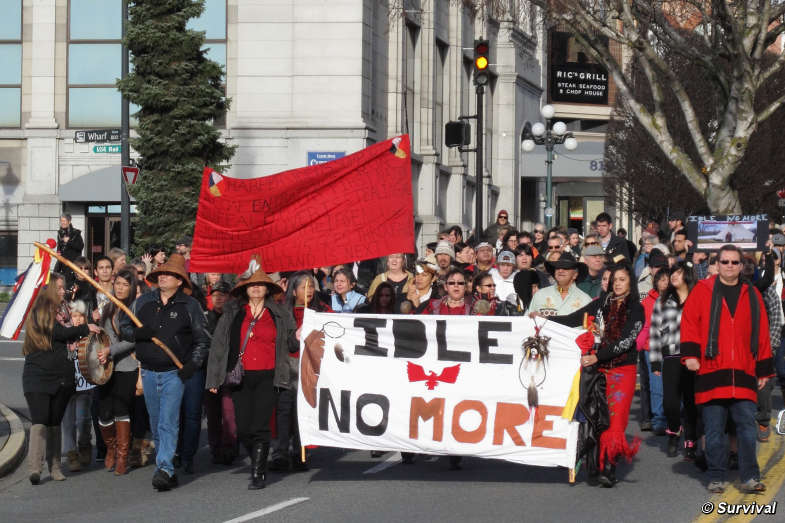
Idle no more protesters marching in Victoria, BC, December 21, 2012.

Native peo­ple across Cana­da have block­ad­ed roads, bridges and rail­way lines as part of the grass-roots indige­nous move­ment Idle No More.

From British Colum­bia, where dozens of pro­test­ers demon­strat­ed out­side hear­ings for a pro­posed oil pipeline, to Ontario, where bor­der cross­ings to the USA were blocked, the scale of the protests strong­ly sug­gest that the move­ment is show­ing lit­tle sign of dying down.

The Idle No More move­ment began in Novem­ber 2012, when four women from the province of Saskatchewan held a ‘teach-in’ about the like­ly effects of Bill C‑45, a large and com­plex bill pro­posed by Prime Min­is­ter Stephen Harp­er, which would seri­ous­ly weak­en many envi­ron­men­tal reg­u­la­tions.

On 4 Decem­ber, a group of chiefs from the Assem­bly of First Nations (AFN), Canada’s prin­ci­pal indige­nous orga­ni­za­tion, were pre­vent­ed from enter­ing the Par­lia­ment build­ings to lob­by MPs over the bill. News of the snub, using the Idle No More hash­tag, quick­ly spread across the coun­try.

Anoth­er impor­tant ele­ment of the protests has been a hunger strike by There­sa Spence, chief of the Attawapiskat First Nation in north­ern Ontario. This Cree com­mu­ni­ty, despite being the loca­tion of De Beers’s Vic­tor dia­mond mine, is riv­en by social prob­lems, includ­ing poor hous­ing and chron­i­cal­ly inad­e­quate edu­ca­tion pro­vi­sion.

Chief Spence declared that her hunger strike would con­tin­ue until the Prime Min­is­ter and the Gov­er­nor Gen­er­al (the Queen’s rep­re­sen­ta­tive in Cana­da), agreed to meet her to dis­cuss Abo­rig­i­nal rights.

On Jan­u­ary 11 a del­e­ga­tion of First Nations lead­ers, under the aegis of the AFN, held a meet­ing with Mr Harp­er and var­i­ous oth­er min­is­ters. The Gov­er­nor Gen­er­al, how­ev­er, did not attend. The meet­ing was incon­clu­sive, with the Abo­rig­i­nal Affairs Min­is­ter report­ing that ‘it would be fol­lowed by high-lev­el dia­logue between the Prime Min­is­ter and Shawn Atleo’, leader of the AFN.

As described by the native writer Lisa Charley­boy, the objec­tives of Idle No More are ‘to build indige­nous sov­er­eign­ty, to repair the rela­tion­ship between indige­nous peo­ples of Cana­da (First Nations, Métis, and Inu­it), the crown, and the gov­ern­ment of Cana­da from a grass­roots frame­work, and to pro­tect the envi­ron­ment for all Cana­di­ans to enjoy for gen­er­a­tions to come.’

Idle No More has called for a World Day of Action on Jan­u­ary 28th.


Six People Arrested Inside Enbridge Hearings

Van­cou­ver, BC / Coast Sal­ish Ter­ri­to­ries – This morn­ing (15th Jan), six peo­ple direct­ly inter­vened in the Enbridge pipeline joint Envi­ron­men­tal Assess­ment and Ener­gy Board hear­ings and put cli­mate change on the agen­da.

Van­cou­ver, BC / Coast Sal­ish Ter­ri­to­ries – This morn­ing (15th Jan), six peo­ple direct­ly inter­vened in the Enbridge pipeline joint Envi­ron­men­tal Assess­ment and Ener­gy Board hear­ings and put cli­mate change on the agen­da. The group man­aged to make their way past police unde­tect­ed and into the secured 4th floor of Vancouver’s Sher­a­ton Wall Cen­ter. Once inside they revealed shirts embla­zoned with mes­sages like “Stop the Pipelines” and pro­ceed­ed to use police tape to cor­don off the hear­ing area as a “cli­mate crime scene.”

“Cli­mate change is killing thou­sands of peo­ple every year, pri­mar­i­ly in devel­op­ing coun­tries and Indige­nous com­mu­ni­ties that are the least respon­si­ble for cre­at­ing this prob­lem. Despite this fact, the Joint Review Pan­el has instruct­ed those par­tic­i­pat­ing in the hear­ings not to talk about cli­mate change. This is a shock­ing­ly irre­spon­si­ble move con­sid­er­ing Canada’s tar sands con­tain twice the amount of car­bon diox­ide emit­ted by glob­al oil use in our entire his­to­ry. New fos­sil fuel pipelines are an irre­spon­si­ble step in the wrong direc­tion.” said Sean Devlin.

The impacts of cli­mate change have been draw­ing glob­al atten­tion recent­ly, between Hur­ri­cane Sandy, unprece­dent­ed dead­ly typhoons in the Philip­pines and pre­vi­ous­ly unimag­in­able tem­per­a­ture records in Aus­tralia. In this urgent con­text the JRP has des­ig­nat­ed cli­mate change and the car­bon emis­sions of Canada’s tar sands “out­side of the panel’s man­date,” a move that offi­cial­ly dis­cour­ages inter­ven­ers from rais­ing these crit­i­cal issues dur­ing their oral state­ments.

“Enbridge and the fed­er­al gov­ern­ment are using their posi­tion of author­i­ty with­in this process to coerce mem­bers of the pub­lic into silence on these issues. The major­i­ty of First Nations and set­tler com­mu­ni­ties in the province oppose fos­sil fuel pipelines. We respect those who are voic­ing their oppo­si­tion to the pipelines inside the hear­ings, but the hear­ing process is mean­ing­less, espe­cial­ly since Harp­er has changed the law, giv­ing his cab­i­net final say on pipeline projects,” said Fiona De Bal­asi Brown.

Today marks the sec­ond day of the Joint Review Pan­el hear­ings in Van­cou­ver and the sec­ond day that the mem­bers of the pub­lic have crossed police lines to make their oppo­si­tion heard. On Mon­day more than a thou­sand pro­test­ers peace­ful­ly forced their way past police onto the Sher­a­ton prop­er­ty drum­ming so loud­ly the noise could be heard inside the hear­ings. Pub­lic out­rage has been embold­ened by a deci­sion to exclude the pub­lic from the hear­ings in Van­cou­ver, a move the BC Civ­il Lib­er­ties Asso­ci­a­tion crit­i­cized yes­ter­day as “poten­tial­ly unlaw­ful.”

The Economics of Insurgency — Thoughts on Idle No More & critical infrastructure

News reports are ablaze with reports of loom­ing Indige­nous block­ades and eco­nom­ic dis­rup­tion.

News reports are ablaze with reports of loom­ing Indige­nous block­ades and eco­nom­ic dis­rup­tion. As the Idle No More move­ment explodes into a new ter­ri­to­ry of polit­i­cal action, it bears to ampli­fy the incred­i­ble eco­nom­ic lever­age of First Nations today, and how fright­ened the gov­ern­ment and indus­try are of their capac­i­ty to wield it.

In recent years, Access to Infor­ma­tion (ATI) records obtained by jour­nal­ists reveal a mas­sive state-wide sur­veil­lance and “hot spot mon­i­tor­ing” oper­a­tion coor­di­nat­ed between the Depart­ment of Indi­an Affairs, the Roy­al Cana­di­an Mount­ed Police (RCMP), the Cana­di­an Secu­ri­ty Intel­li­gence Ser­vice (CSIS), local secu­ri­ty forces, nat­ur­al resource and trans­porta­tion min­istries, bor­der agen­cies, and indus­try stake­hold­ers. These efforts have been explic­it­ly mobi­lized to pro­tect “crit­i­cal infra­struc­ture” from Indige­nous attack.

What is crit­i­cal infra­struc­ture? Accord­ing to an RCMP inter­nal doc­u­ment con­cern­ing the risk of Abo­rig­i­nal protest, “crit­i­cal infra­struc­ture refers to infra­struc­ture, both tan­gi­ble and intan­gi­ble, that is essen­tial to the health, safe­ty, secu­ri­ty or eco­nom­ic well-being of Cana­di­ans and the effec­tive func­tion­ing of gov­ern­ment.” RCMP Nation­al Secu­ri­ty Crim­i­nal Inves­ti­ga­tions have pri­or­i­tized four crit­i­cal infra­struc­ture sec­tors: finance, trans­porta­tion, ener­gy, and cyber-secu­ri­ty.

On Jan­u­ary 5 alone, INM protests includ­ed five bor­der cross­ing block­ades, bridge block­ades, and rail line dis­rup­tions span­ning the coun­try.

And it’s not only intel­li­gence ser­vices that are warn­ing of threats to crit­i­cal infra­struc­ture.

Con­ser­v­a­tive mil­i­tary ana­lyst Dou­glas Bland has also long warned that Canada’s eco­nom­ic vul­ner­a­bil­i­ty is based on the “crit­i­cal infra­struc­ture that trans­ports nat­ur­al resources and man­u­fac­tured goods from mines, oil fields, hydro-elec­tric facil­i­ties and fac­to­ries to inter­na­tion­al mar­kets.” With­out these crit­i­cal sys­tems, he cau­tions, “Canada’s econ­o­my would col­lapse.”

Though Bland has coun­seled a con­cil­ia­to­ry approach to Abo­rig­i­nals in order to stave off the com­ing cri­sis, his alarmism – and that of oth­er right-wing pun­dits – simul­ta­ne­ous­ly jus­ti­fies the state’s secu­ri­ty and sur­veil­lance appa­ra­tus by man­u­fac­tur­ing a fear of native upris­ing. But for Bland and oth­ers, a com­ing “Native Spring” is less feared for its poten­tial “vio­lence” and all the more grave for its threat to prop­er­ty rights.

In Bland’s fic­tion­al book Upris­ing, he pre­dicts coor­di­nat­ed attacks by secret native cells on key instal­la­tions and urban hubs, such as the James Bay hydro-elec­tric dam and the down­town core of Win­nipeg. This attack on crit­i­cal infra­struc­ture telling­ly ends in a blaze of hero­ic Cana­da-US mil­i­tary attacks on the rebel army. (The US gets involved only when they real­ize their source of elec­tric­i­ty, oil, and gas is at stake.)

Here­in lies the real role of right wing alarmists in the INM move­ment: to main­tain the eco­nom­ic sta­tus quo, because ter­ri­to­ry is cap­i­tal. Land is mon­ey. And the cir­cu­la­tion of goods, resources and ener­gy through ter­ri­to­ry is the very essence of cap­i­tal­ism today.

The fact is that crit­i­cal infra­struc­ture in Cana­da is at the mer­cy of Indige­nous peo­ples, who are more rur­al than Cana­di­ans and have access to impor­tant arter­ies for eco­nom­ic flows: trans­porta­tion cor­ri­dors, ener­gy sec­tors, and sites of nat­ur­al resource extrac­tion.

This vul­ner­a­bil­i­ty is dead­ly to the logis­tics indus­try. Logis­tics is a busi­ness sci­ence con­cerned with the man­age­ment of goods and infor­ma­tion through glob­al sup­ply chains. As the World Bank has declared: “A com­pet­i­tive net­work of glob­al logis­tics is the back­bone of inter­na­tion­al trade.” For an indus­try depen­dent on main­tain­ing open chan­nels for cap­i­tal cir­cu­la­tion, a block­ade means mas­sive loss­es: the truck­ing indus­try alone is worth $65 bil­lion and employs more than 260,000 dri­vers.

In the ener­gy sec­tor, Cana­da has oil reserves sec­ond in the world after Sau­di Ara­bia, though less acces­si­ble – 98 per cent of this oil is in Alber­ta and 95 per cent of it is in the tar sands, where effec­tive Indige­nous resis­tance by Treaty 8 and oth­er First Nations has led to glob­al boy­cott cam­paigns and fierce resis­tance.

In north­ern BC, the Unist’ot’en Clan, with sup­port from grass­roots Wet’suwet’en, have built a com­mu­ni­ty of resis­tance direct­ly on the GPS co-ordi­nates of the pro­posed pipeline route from the Alber­ta tar sands to the Kiti­mat port. From this camp they have evict­ed sur­vey­ors work­ing for Pacif­ic Trails Pipeline. Mean­while, in Ontario, Enbrdige’s Line 9 has been has been opposed by the Onei­da, the Hau­denosaunee Devel­op­ment Insti­tute, and Aami­ji­waang First Nation, who have all vowed to fight the pipeline to pro­tect their lands and waters.

In terms of nat­ur­al resource extrac­tion, over 10 per cent of Canada’s econ­o­my is com­prised of the nat­ur­al resources sec­tors and earth sci­ence indus­tries, which direct­ly employ close to 763,000 peo­ple. The great­est con­cen­tra­tion and cor­re­la­tion between Indige­nous lands and min­er­al claims are being cur­rent­ly devel­oped in the north­ern mod­ern treaties and ter­ri­to­ries, such as Nunavut; Yukon; the James Bay region of Que­bec, and the Que­bec-Labrador bor­der; on unced­ed north­west­ern BC lands (e.g. on Nakazdli, Tzal­ten, and Tlin­git tra­di­tion­al ter­ri­to­ry); and in north­ern Ontario’s “Ring of Fire” on his­toric treaty lands, par­tic­u­lar­ly Treaties 3 and 9.

In addi­tion to min­er­al resources, over half of large intact for­est land­scapes are found on lands in his­tor­i­cal Abo­rig­i­nal treaty areas. More specif­i­cal­ly, as Glob­al For­est Watch reports, “Treaties 8 and 9 con­tain about a quar­ter of all of Canada’s intact for­est land­scapes and close to half of all the intact for­est land­scapes that occur with­in treaty areas. Mod­ern land claim set­tle­ments con­tain about a quar­ter of Canada’s intact for­est land­scapes.”

That is not to say mean­ing­ful con­sul­ta­tion con­cern­ing crit­i­cal infra­struc­ture has not been tak­ing place. The prob­lem is that it has exclu­sive­ly been between indus­try and gov­ern­ment, instead of between Indige­nous peo­ples and the state. Jour­nal­ists have been uncov­er­ing mul­ti­ple inci­dents of high-lev­el co-ordi­na­tion between indus­try and gov­ern­ment offi­cials. For exam­ple, Access to Infor­ma­tion requests revealed that the gov­ern­ment has been shar­ing infor­ma­tion with the oil indus­try on envi­ron­men­tal­ists and Indige­nous groups twice a year since 2005 at secret brief­in­gs, even on such seem­ing­ly irrel­e­vant activ­i­ties such as par­tic­i­pa­tion in anti-G20 demon­stra­tions.

The irony is that many cor­po­ra­tions are tired of hav­ing oper­a­tions held up by Indige­nous protest and are will­ing to go fur­ther than gov­ern­ments to rec­og­nize Indige­nous rights. The log­ics of colo­nial­ism and cap­i­tal­ism divide here around con­flict­ing objec­tives of ter­ri­to­r­i­al acqui­si­tion ver­sus the cir­cu­la­tion of goods. But more often than not, the state and indus­try con­verge around the com­mon inter­ests of the rul­ing class. For Indige­nous peo­ples, this becomes a ques­tion of co-ordi­nat­ing lever­age.

In con­clu­sion, I want to high­light three main con­cerns expressed in the risk assess­ments under­tak­en by RCMP, CSIS, Indi­an Affairs, and right-wing thinkers on Indige­nous upris­ing that fore­ground Indige­nous eco­nom­ic pow­er.

The first is that a mis­han­dling of con­flict will gal­va­nize co-ordi­nat­ed efforts of First Nations across the coun­try; hence the rel­a­tive­ly hands-off approach tak­en until now. In the Fed­er­al Coor­di­na­tion Frame­work for the AFN Day of Action in 2007, the pro­posed solu­tion in the case of co-ordi­nat­ed mobi­liza­tion is to “iso­late the splin­ter group.”

Sec­ond, the eco­nom­ic cost of even a few hours of such co-ordi­nat­ed efforts would be crip­pling and impos­si­ble to police giv­en cur­rent resources.

Third – and this is one of the most wor­ri­some trends to observers – sol­i­dar­i­ty and co-ordi­na­tion between non-Natives and Indige­nous peo­ples will encour­age the move­ment to build.

As a final thought, while the gen­er­al pop­u­la­tion might have been tak­en by sur­prise by the strength of Idle No More, the gov­ern­ment had long pre­pared for this inevitabil­i­ty. As far back as 2008, when changes were first pro­posed to the Nav­i­ga­ble Waters Act, CSIS’s Inte­grat­ed Threat Assess­ment Cen­tre warned about “poten­tial unrest.”

Cana­da cre­at­ed the cri­sis of insur­gency. Canada’s greed cre­at­ed a sit­u­a­tion where Indige­nous peo­ples stand with almost noth­ing to lose. There­fore, the fight is theirs to take. It is also ours to sup­port.

Read the full arti­cle here.

Ecuadorian Indigenous Village Threatens to “Die Fighting” Against Oil Company — 15th Jan


An indige­nous com­mu­ni­ty in the Ecuado­ri­an rain­for­est says they “will die fight­ing to pro­tect the rain­for­est” after they say they were swin­dled by an oil com­pa­ny into sign­ing away rights to 70,000 hectares of one of the most bio­di­verse areas in the world.


An indige­nous com­mu­ni­ty in the Ecuado­ri­an rain­for­est says they “will die fight­ing to pro­tect the rain­for­est” after they say they were swin­dled by an oil com­pa­ny into sign­ing away rights to 70,000 hectares of one of the most bio­di­verse areas in the world.

But the state-backed oil com­pa­ny, PetroAmazonas—backed by the Ecuadore­an army—plans to begin prospect­ing the Kich­wa vil­lage on the Napo Riv­er on Tues­day, The Guardian reports.

PetroA­ma­zonas, one of the biggest oil com­pa­nies in South Amer­i­ca, orig­i­nal­ly offered the vil­lage a new school, uni­ver­si­ty places for vil­lage chil­dren and bet­ter health­care, but dropped those pro­vi­sions before the chief of the vil­lage signed away the rights to the land for $40 per hectare.

But the com­mu­ni­ty sec­re­tary, Klid­er Gualin­ga, said 80 per­cent of the vil­lage oppos­es the deal, which he says has not yet been final­ized. “Peo­ple think it is dis­hon­est and the oil com­pa­ny is treat­ing them like dogs. … They’re very upset and wor­ried. We have decid­ed to fight to the end. Each land­hold­er will defend their ter­ri­to­ry. We will help each oth­er and stand shoul­der to shoul­der to pre­vent any­one from pass­ing.”

“If there is a phys­i­cal fight, it is cer­tain to end trag­i­cal­ly,” Shaman Patri­cio Jipa said. “We may die fight­ing to defend the rain­for­est.”

He con­tin­ued:

It makes me feel sad and angry. Sad because we are indige­nous peo­ple and not ful­ly pre­pared to fight a gov­ern­ment. And angry because we grew up to be war­riors and have a spir­it to defend our­selves. I wish we could use this force to fight in a new way, but our men­tal strength is not suf­fi­cient in this mod­ern world.

[…]

There is huge con­cern the oil com­pa­ny will move quick­ly to clear the land. When that hap­pened else­where, they used armed troops, beat­ings and abduc­tions to remove those who stood in their way.

Jipa and his wife, Mari Muench, a British busi­ness­woman, are fight­ing the plan.

Sci­en­tists say a sin­gle hectare in this part of the Ama­zon con­tains a wider vari­ety of life than all of North Amer­i­ca. The Ama­zon rain­for­est and oth­er trop­i­cal forests are also among the earth­’s best defens­es against cli­mate change, absorb­ing some 20 per­cent of car­bon diox­ide pro­duced by burn­ing fos­sil fuels.

“Pro­tect­ing the Ama­zon basin, which con­tains the largest trop­i­cal rain­for­est on the plan­et, is crit­i­cal to our plan­et’s cli­mate sta­bil­i­ty,” accord­ing to Ama­zon Watch.

Self-Determination and Self-Defense in Cherán, Michoacán

On Decem­ber 11, 2012, the US Jus­tice Depart­ment announced that bank­ing giant HSBC was immune from pros­e­cu­tion despite over­whelm­ing evi­dence that they con­sis­tent­ly failed to imple­ment con­trols against mon­ey-laun­der­ing. Assis­tant attor­ney gen­er­al Lan­ny Breuer said: “Had the US author­i­ties decid­ed to press crim­i­nal charges, HSBC would almost cer­tain­ly have lost its bank­ing license in the US, the future of the insti­tu­tion would have been under threat and the entire bank­ing sys­tem would have been desta­bi­lized.”

The entire bank­ing sys­tem would have been desta­bi­lized?


The Depart­ment of Jus­tice opt­ed rather to charge HSBC a record-break­ing 1.9 bil­lion dol­lar fine, and ordered the bank’s activ­i­ties mon­i­tored for five years. The 1.9 bil­lion is equiv­a­lent to five weeks’ worth of HSBC earn­ings, in oth­er words, a drop in the buck­et. The sad­dest part of the sto­ry in the main­stream media, is the focus on mon­ey laun­dered and mon­ey fined, as opposed to lives lost and crime legit­imized in one of the most grotesque admis­sions of com­plic­i­ty with orga­nized crime in the so-called war on drugs. Basi­cal­ly what was announced to the world by the US Jus­tice Depart­ment was that the mon­ey ran too thick, and the crim­i­nals were too pow­er­ful. The glob­al eco­nom­ic impact of pros­e­cut­ing a bank where the dirty mon­ey has been going, was too dan­ger­ous to risk. “Sor­ry kids, but we guess the bad guys win.”

In Cher­an, Michoa­can, Mex­i­co the news of HSBC’s immu­ni­ty from crim­i­nal pros­e­cu­tion and US sanc­tions comes as no sur­prise. Orga­nized crime has been preva­lent in the com­mu­ni­ty since 2000. After a 2008 may­oral race that left a PRI (Insti­tu­tion­al Rev­o­lu­tion­ary Par­ty) can­di­date in office, illic­it activ­i­ty increased sub­stan­tial­ly. The com­mu­ni­ty learned that orga­nized crime is an inte­gral part of local pol­i­tics and eco­nom­ics every­where. Cher­an is a beau­ti­ful small indige­nous Purepecha moun­tain com­mu­ni­ty sur­round­ed by pre­cious forests, that knows the true cost of those prof­its laun­dered. Imme­di­ate­ly after the 2008 may­oral race the com­mu­ni­ty began expe­ri­enc­ing the dev­as­tat­ing effects of dog eat dog cap­i­tal­ism of which orga­nized crime is only anoth­er part.

The ille­gal log­ging indus­try began to rav­age the community’s most pre­cious forests, which have been tra­di­tion­al­ly respect­ed as a spir­i­tu­al con­nec­tion by the Indige­nous Purepecha peo­ple to their ter­ri­to­ry. The log­ging began to look a lot more like pil­lag­ing and when com­mu­ni­ty mem­bers began to attempt to defend their forests, they were met with a real life night­mare: the log­gers were not only aid­ed and pro­tect­ed by gov­ern­ment agen­cies and local police, the entire log­ging oper­a­tion was being coor­di­nat­ed by mem­bers of a major orga­nized crime syn­di­cate. [To this day I am told by com­mu­ni­ty mem­bers not to name the actu­al syn­di­cate in any­thing I write or say, or risk an almost cer­tain death.]

The first com­mu­ni­ty mem­bers who began to defend their for­est were sim­ply and quick­ly assas­si­nat­ed. From 2008–2011 the sit­u­a­tion only became worse. Crim­i­nals charged pro­tec­tion to run even a small busi­ness in the com­mu­ni­ty of Cher­an. The for­est was raped and ter­ror reigned as any­one felt at risk. The city would become a ghost town by sun­set. This is a real­i­ty con­front­ed by too many com­mu­ni­ties in Mex­i­co every day.

Mur­ders, dis­ap­pear­ances, kid­nap­pings, the crim­i­nal amounts of ille­gal log­ging and the reign of ter­ror came to a head on the ear­ly morn­ing of April 15th, 2011. A group of women had begun qui­et­ly orga­niz­ing in the days before an action to bring the rav­aging of their town to a halt. On April 15th, with chil­dren and youth at their sides, the women rose up and attempt­ed to detain log­gers trav­el­ing through town. The log­gers tried to run the women over and in response the com­mu­ni­ty react­ed as a whole, and began burn­ing the log­gers’ vehi­cles and began detain­ing the log­gers them­selves.

It is at this point that the com­mu­ni­ty rec­og­nized the com­plic­i­ty of the local police when it was police offi­cers who guid­ed orga­nized crime thugs to the place where the log­gers were being held, in an attempt to vio­lent­ly release them. The com­mu­ni­ty erect­ed “fogatas” or bon­fire bar­ri­cades through­out town in order to pre­vent vio­lence against com­mu­ni­ty mem­bers. With­in days the com­mu­ni­ty decid­ed that it no longer trust­ed any politi­cians from any polit­i­cal par­ty or any of the local and state police. They began to orga­nize for self-deter­mi­na­tion and self-defense and chose to return to their tra­di­tion­al Purepecha forms of self gov­er­nance.

A gen­er­al coun­cil of com­mu­ni­ty elders was elect­ed and com­mis­sions were formed in order to car­ry out the community’s logis­ti­cal, social, eco­nom­ic, and polit­i­cal needs. Com­mu­ni­ty mem­bers sim­ply say that they referred to their his­to­ry and referred to their elders in order to return to the way the com­mu­ni­ty was orga­nized before polit­i­cal par­ties, police, and orga­nized crime exist­ed. The gen­er­al coun­cil is legal­ly rec­og­nized as the gov­ern­ing body of Cher­an, Michoa­can today.

The com­mu­ni­ty has main­tained that they only have three demands: safe­ty, jus­tice, and the refor­esta­tion of their ter­ri­to­ry. They have active­ly been refor­est­ing the entire region and take that aspect of their strug­gle very seri­ous­ly, and remind us that for them pro­tect­ing the for­est is both a tra­di­tion­al and a spir­i­tu­al oblig­a­tion. Cher­an does not believe that any­body will ever be able to bring them jus­tice for their dead, dis­ap­peared, and dis­placed as a result of the con­flict, nor do they expect any­one in pow­er to under­stand the jus­tice they seek for the for­est. Today Cher­an knows that jus­tice is some­thing that they will have to take care of obtain­ing on their own from now on. When it comes to safe­ty, the world is able to see what it looks like for a com­mu­ni­ty to take respon­si­bil­i­ty for its own safe­ty through tra­di­tion­al indige­nous forms of self gov­er­nance and self-defense.

Short­ly after the 2011 upris­ing began, com­mu­ni­ty mem­bers state that the local politi­cians and the police sim­ply exiled them­selves in fear from the com­mu­ni­ty, war­rant­i­ng no need to run them out of town. Com­mu­ni­ty mem­bers took the local gov­ern­ment offices, took police trucks, took the polices’ weapons, and put them all to use. His­tor­i­cal­ly, Cher­an had tra­di­tion­al­ly been “policed” or defend­ed by mem­bers from the com­mu­ni­ty. In a vol­un­tary rota­tion mem­bers from each of the four “bar­rios” or neigh­bor­hoods would patrol the com­mu­ni­ty for self-defense in what is known as the “com­mu­ni­ty ron­da.” After the upris­ing the gen­er­al coun­cil made a call out for vol­un­teers to par­tic­i­pate in the com­mu­ni­ty “ron­da”, or com­mu­ni­ty guard. Com­mu­ni­ty mem­bers main­tain that police are imposed by the gov­ern­ment, but the “ron­da” is a tra­di­tion­al way in which com­mu­ni­ty mem­bers pro­tect them­selves and their com­mu­ni­ty. Today the “ron­da” is sep­a­rat­ed into two parts. The “ron­da comu­ni­taria” which is respon­si­ble for patrolling and pro­tect­ing the com­mu­ni­ty from with­in its bor­ders and the “guard­a­bosques” or for­est defend­ers, which patrol the out­skirts of town and deep into the forests in order to pro­tect com­mu­ni­ty mem­bers liv­ing in those more rur­al areas and in order to pro­tect the for­est itself.

Cher­an is not the first com­mu­ni­ty in Mex­i­co to return to their tra­di­tion­al means of com­mu­ni­ty self-defense, nor is it the first place in the state of Michoa­can, nor in the indige­nous Purepecha region. Oth­er com­mu­ni­ties have engaged in sim­i­lar prac­tices of self gov­er­nance and self-defense, and lit­tle by lit­tle more and more com­mu­ni­ties are see­ing tra­di­tion­al self gov­er­nance and self-defense as a viable alter­na­tive to cor­rupt pol­i­tics and sub­mis­sion to orga­nized crime. Recent­ly coun­cil mem­bers from Nurio, Michoa­can, a larg­er com­mu­ni­ty and long time prac­ti­tion­er of self gov­er­nance and self-defense, sug­gest­ed that the entire Purepecha region should begin to orga­nize a region­al “ron­da” that could poten­tial­ly coor­di­nate self-defense patrols on a region­al lev­el for the indige­nous Purepecha peo­ple liv­ing through­out the state of Michoa­can.

It is hard not to throw your hands up in the air in res­ig­na­tion when you hear about crim­i­nals such as HSBC being grant­ed immu­ni­ty from pros­e­cu­tion and sanc­tions, but it is even hard­er not to throw a fist in the air when you see indige­nous Purepe­chas suc­cess­ful­ly over­com­ing orga­nized crime, cor­rupt politi­cians, and big busi­ness by estab­lish­ing mod­els for self-deter­mi­na­tion and self-defense, on a com­mu­ni­ty lev­el.

Simòn Sedil­lo

Idle No More International Day of Action – January 28, 2013

14th Jan 2012.

14th Jan 2012. Indige­nous Resur­gence Explodes with Idle No More Day of Action

Idle No More grass­roots founders and orga­niz­ers from across Cana­da, in sol­i­dar­i­ty with com­mon caus­es – a new ini­tia­tive bring­ing togeth­er social jus­tice, envi­ron­men­tal, labour and oth­er Activist Groups…

- UNITED we are plan­ning IDLE NO MORE WORLD DAY OF ACTION on Jan­u­ary 28th, 2013 #J28.

This day of action will peace­ful­ly protest attacks on Democ­ra­cy, Indige­nous Sov­er­eign­ty, Human Rights and Envi­ron­men­tal Pro­tec­tions when Cana­di­an MPs return to the House of Com­mons on Jan­u­ary 28th. As a grass­roots move­ment, clear­ly no polit­i­cal orga­ni­za­tion speaks for Idle No More. This move­ment is of the peo­ple… For The Peo­ple! #IDLENOMOREFTP

The Vision of IDLE NO MORE revolves around Indige­nous Ways of Know­ing root­ed in Indige­nous Sov­er­eign­ty to pro­tect water, air, land and all cre­ation for future gen­er­a­tions.

The Con­ser­v­a­tive gov­ern­ment bills begin­ning with Bill C‑45 threat­en Treaties and this Indige­nous Vision of Sov­er­eign­ty.

The Goal of the move­ment is edu­ca­tion and the revi­tal­iza­tion of Indige­nous peo­ples through Aware­ness and Empow­er­ment.  IDLE NO MORE has suc­cess­ful­ly encour­aged knowl­edge shar­ing of Indige­nous Sov­er­eign­ty and Envi­ron­men­tal Pro­tec­tions. 

This mes­sage has been heard around the world and the world is watch­ing how Cana­da responds to the mes­sage sent by many INM Sup­port­ers.

INM urges the gov­ern­ment of Cana­da to repeal all leg­is­la­tion; which vio­lates Treaties, Indige­nous Sov­er­eign­ty and sub­se­quent­ly Envi­ron­men­tal Pro­tec­tions of land and water.

INM is grate­ful to many lead­ers who have sup­port­ed this vision and the move­ment of the grass­roots peo­ple.

“The Treaties are the last line of defense to pro­tect water and lands from destruc­tion,” stat­ed Oren Lyons, Faith­keep­er Tur­tle Clan, Ononda­ga Nation Coun­cil of Chiefs.

Please watch and share this video of the Idle No More action in Toron­to, and orga­nize events in sol­i­dar­i­ty with Idle No More with­in your local col­lec­tives: